Insulin stops being safe to use once it drifts outside a narrow temperature window. That fact sat somewhere in the back of my mind for years, filed under things we'd probably never need to think about until our second week-long power outage in twelve months, when it moved straight to the front.
We live outside Houston, and our son needs his insulin kept in that window every single day, storm or not. During that second outage we were tracking it with a drugstore thermometer taped to the inside of a cooler while my husband cycled ice packs for three straight days. I lost those same three days trying to keep a home office running on a phone hotspot and a dying laptop battery, and emergency backup power stopped being a hypothetical the moment those two problems collided in the same week.
Two Houston Outages Taught Us We'd Built the Wrong System
The first outage was the one that scared us into buying things without thinking them through. We grabbed the biggest gas generator on the shelf, on the theory that more power solves everything. It doesn't. My husband spent an evening in the rain trying to pull-start it while I held a flashlight, and the extension cords running through the house afterward turned every hallway into a tripping hazard for the kids.
We know now that the first hour of any outage goes the same way every time — check the medical fridge, then the router, then whatever's plugged into a deadline, roughly in that order, instead of grabbing whatever's loudest and hoping it helps.
The Generator That Ran Us Ragged
Somewhere between the first and second outage, my husband ordered a DIY magnetic generator kit off the back of a YouTube ad promising free, unlimited power with no fuel and no noise. It arrived in pieces, with instructions that assumed we already knew how to build it, and it never ran a single watt in our house. Any pitch that promises free energy with no fuel and no trade-offs is worth doubting on principle, and that kit cured us of ever falling for one again.
A neighbor down the street, the kind of guy who spends his weekends on woodworking projects in his home workshop, was the one who talked us out of buying a second gas generator instead. He pointed out that a loud generator running at midnight is its own kind of problem when you've got neighbors — trading noise for runtime is a real cost, not a footnote, and it's part of why we leaned toward battery power for the smaller loads.
We Didn't Need a Whole-Roof Solar Array
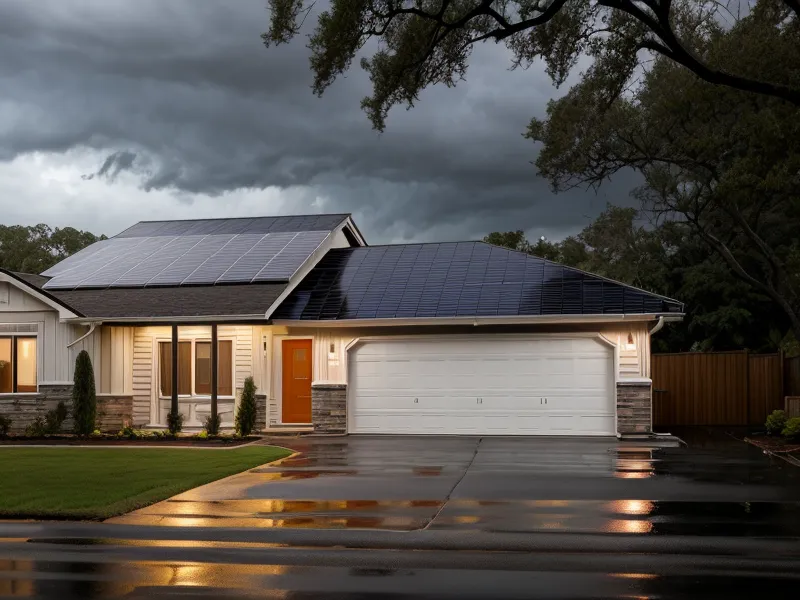
We looked hard at those whole-house solar arrays with wall-sized battery banks before deciding against them. They're impressive on paper, but running one well means understanding load balancing, inverter sizing, and battery management well enough to troubleshoot mid-storm, and neither of us wanted a second job in electrical engineering. Grid independence sits on a spectrum, and going all the way to the far end of it wasn't the right fit for a family that just needed the essentials covered.
My husband is the one who tests everything, and he settled on a hybrid setup instead: portable LiFePO4 power stations for my home office, plus a manual transfer switch for the refrigerator. Comparing battery power against a generator isn't really an either-or question once you've lived through an outage — we use both, for different jobs. He installed the transfer switch himself over a weekend, following the unit's documentation closely, though we'd tell anyone doing the same to have a licensed electrician check the work before relying on it. We also learned that LiFePO4 battery chemistry holds up over roughly 3,000 charge cycles, which is part of why we picked it over the cheaper batteries we almost bought.
Tracking the Watts That Actually Mattered
I tracked every watt before we spent another dollar on equipment, because guessing at capacity is how you end up with a power station that dies halfway through a workday. A laptop draws around 60 watts, easy for a small unit, but the refrigerator needed a pure sine wave inverter built for standard 120-volt household circuits so the compressor wouldn't get damaged during the switch. You don't need to start with a whole-house system to cover the basics — a lot of families get real protection out of a modest setup built around just the essentials, and we wrote more about that math in after two blackouts and a ruined deadline: our family's path to real home power independence.
Testing Through Storms, From Freeze to Flood
The real test wasn't the outage that scared us — it was the freeze in the dead of winter, then a fresh round of storms in spring, then more in summer, back to back, with the new setup running the whole way through. Instead of dragging out a loud generator at midnight like half the street, we flipped a few switches and kept going. Layering a few different backup levels — batteries for daily essentials, the generator in reserve, rotated fuel as a last resort — turned out to matter more than any single piece of equipment we owned, something we go into more in keeping the lights on and the insulin cold: our journey beyond gas generators.
Gasoline doesn't keep the way people assume it does. It can start breaking down in as little as thirty days without stabilizer, so my husband rotates ours through the lawnmower every few months instead of letting full cans sit untouched in the garage. Carry a full five-gallon can any real distance and you'll know exactly which shoulder complains first — that's reason enough on its own to keep the rotation small and frequent.
Ten weeks or so into running the hybrid setup, checking on the insulin stopped being something we braced for. I opened the kitchen drawer where we keep his pen mid-storm one afternoon, more out of habit than worry, and it was just cold — completely fine, like nothing outside had changed at all. The kids needed somewhere to burn off energy once the video games died that same week, so we walked over to Sugar Land Town Square for a couple of hours instead of sitting around watching the storm.
Start With the Fridge, Not the Whole House
Last month the streetlights went out again during a bad thunderstorm, and I just kept working on a client's logo while the router stayed on and the deadline stayed intact. That's the whole goal, really — not some massive independence project, just a house that keeps functioning when the Texas power grid has a bad night.
If you're just starting out, don't try to cover the whole house on day one. Start with the one appliance you truly can't live without — a medical fridge, a sump pump, a home office setup — and build outward from there once that piece is solid. That's the lesson two bad years taught us: cover your one non-negotiable first, and let the rest of the system grow around it.
Nothing on this website constitutes medical, legal, or financial advice. All content is based on the author's personal experience and independent research. Consult a licensed professional for guidance specific to your situation.