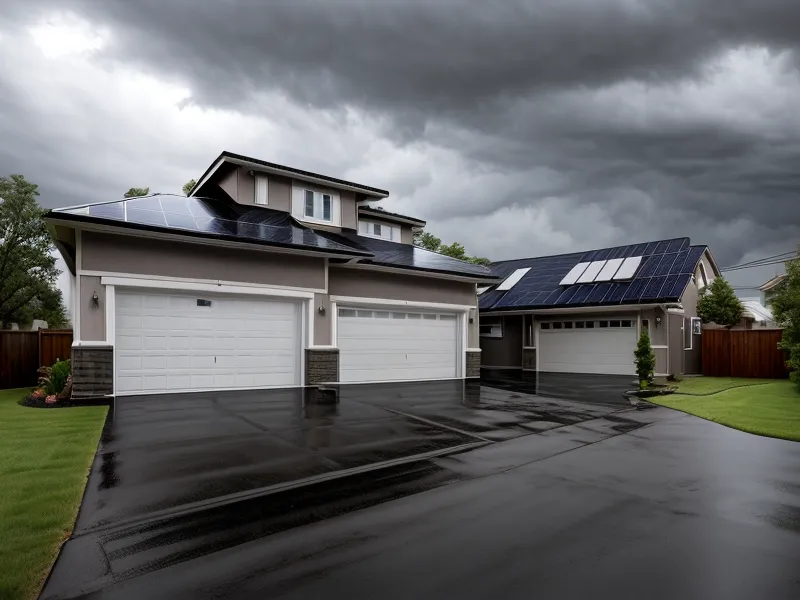
He's got the multimeter clipped to the output leads before the porch light even finishes its second flicker, calling numbers over his shoulder while I stand in the kitchen doorway timing it on my phone. This is just reflex now, not a special occasion. Two extended outages in one year outside Houston will turn any family into the kind that tests things before the storm even has a name. This flicker resolves itself in under a minute. We still run the check anyway — the gap between "the lights blinked" and "we lost three days" is exactly the gap we built our whole emergency power setup to close.
Quick disclosure before anything else: some of the links below are affiliate links, and if you buy through them we earn a small commission at no extra cost to you. We only recommend backup power products we've actually plugged into a wall and tested against a real outage. Our youngest is Type 1 diabetic, which is a detail that comes up constantly in this house, because it's the reason this stopped being a hobby project and became a household requirement. Neither of us is an electrician. Neither of us is a prepper. We're two parents who got tired of losing client deadlines and hovering over a cooler.
Two Houston Outages Was Enough
Last year gave us two extended blackouts in six months, which is two more than most families need before they change something. For me — freelance graphic design, deadlines that don't pause for the grid — it meant several unpaid days and two clients asking pointed questions about reliability. For our son, it meant a cooler packed with ice, a running list of nearby gas stations, and a thermometer we checked more often than our phones. Insulin has to stay within a narrow temperature range, and a narrow temperature range does not care that the transformer down the street just failed again. We're not medical professionals, and if you're keeping something like insulin cold on backup power, talk to your own care provider about safe storage — don't take our word over theirs.
We didn't jump straight to a fix. We read through a lot of half-answers first, including a neighbor's own account, How I Built a Simple Backup Power System for Under 200 Dollars, which is where the idea of building rather than buying first took hold for us. Somewhere in that research phase we landed on the Energy Revolution System as the build worth actually testing against our specific loads — the router, my workstation, and the medical fridge, nothing more ambitious than that. We also spent an evening reading up on the energy storage principles behind these builds, mostly so we'd know whether we were buying a real mechanism or just a nicely designed PDF.
Our DIY Energy Detour That Arrived in Pieces
Before any of that research paid off, though, there was the kit. He'd seen an ad mid-scroll on YouTube for a DIY magnetic generator kit promising whole-house independence for less than a nice dinner out, and he ordered it without running it past me first. It showed up two weeks later in a box that rattled — no pre-assembly, no wiring harness, just raw parts and a photocopied instruction sheet that assumed a level of electrical knowledge neither of us has. We never got it running. It sat on the workbench for a month before it went into the donate pile.
That failure taught us something useful, though: a guide that shows its work — step by step, video by video — is worth more than a box of loose parts and a promise. Every DIY system we've tested since gets judged against that one measuring stick first, before we even look at output numbers.

So Which System Do You Actually Need?
Before comparing products, we calculated our actual essential wattage — router, laptop, one fridge compressor's startup surge — instead of guessing. That kind of runtime math deserves its own deep dive, but the short version is this: your number is never going to look like anyone else's. A neighbor of ours who spends his weekends on woodworking projects in his home workshop has an entirely different problem, since a table saw and a dust collector pull more than our whole essential list combined. Ours turned out small by comparison, and that smallness is exactly what let us choose something compact instead of a system built for an entire house.
The Energy Revolution System ended up as our main unit — sized for the router, the workstation, and the medical fridge running together, including the surge a compressor throws when it kicks on. It's a blueprint you assemble yourself rather than a box that shows up ready to plug in, and that was the trade-off we were willing to make in exchange for actually understanding what sits in our house. Medical-priority loads like an insulin fridge deserve first claim on whatever capacity you build, ahead of phones, ahead of WiFi, ahead of anything else competing for the same watts.
Smaller and simpler is the Orgone Motor's whole pitch: a lower ceiling on what it can run, but genuinely better suited to an apartment or a rental than our house. We took it out one evening to Sugar Land Town Square to see how it handled being away from home entirely, running a couple of phone chargers and a small lamp while the kids played nearby, and it did the job without complaint. We wrote up the fuller story of how the Orgone Motor kept our insulin fridge running during that earlier test, if you want the details. It's the right call for someone who needs the essentials covered in a smaller space, not a whole home office.
Then there's the Power Grid Generator, built around a resonance-based recovery approach — engineering language for squeezing more usable output out of a simple design — and priced as the most accessible entry point of the three. It's less consistent under a heavier load than the Energy Revolution System, but for someone whose entire goal is keeping phones charged and WiFi alive, nothing more dramatic than that, it's a reasonable place to start. That's really the whole battery-versus-generator argument in miniature: a gas generator solves for raw output regardless of noise, while a DIY build like these solves for quiet, low-maintenance coverage of a shorter list. Which one wins depends entirely on what's actually on your list.

Wiring It In Without Calling an Electrician First
Handing off now — I'm the one who actually builds these things, not her. After four years of chasing better backup power for this house, I've learned that "DIY" scares people more than it should. I'm not an electrician, and if you're not confident around a breaker panel, that's exactly when you call one — don't let a blog post talk you out of that. But the Energy Revolution System guide breaks the build into small enough steps that someone with zero electrical background can follow it in a single free afternoon, using tools most households already own.
There's a real distinction worth knowing here: a plug-in backup unit you assemble yourself is a different animal from a hard-wired whole-house system, which legitimately requires a licensed electrician and a permit. Ours is the first kind. The build itself wasn't glamorous — a cleared workbench, parts sorted by step, nothing skipped, nothing rushed.
What confirmed it worked wasn't the voltage reading at all. It was walking to the kitchen drawer afterward, pulling out our son's insulin pen mid-test, during a downpour with the LED readout glow bouncing dimly off the wall behind me, and finding the pen exactly as cool as it should have been. No drama. No melted ice. Nothing to report, which was the entire point. We've since had to unlearn a few assumptions about independent energy that turned out to be closer to myth than fact — you can read the truth about independent energy we used to believe, if you've fallen for the same ones we did.

Where Each System Actually Wins
Here's the honest breakdown, no hedging. Choose the Energy Revolution System when your list includes something that genuinely cannot fail — a medical fridge, a home office income stream, anything where "we'll figure it out" isn't an acceptable plan. Choose the Orgone Motor when your space is small, your budget is tighter, and your list is genuinely short: phones, a lamp, maybe a laptop. Choose the Power Grid Generator when phones and WiFi are the entire goal and you're comfortable with a system that's newer and less proven than the other two.
None of these sit at the far end of full grid independence, either — that's a much wider spectrum, stretching all the way from a single power strip to a whole-home battery bank costing many times what any of these three do. We landed somewhere in the modest middle of that spectrum on purpose, because modest is what actually matched our house and our list, not someone else's.
Don't Wait For The Next Warning
A purple-tinted sky doesn't always mean something is coming — most of the time it's just rain. But the two times it wasn't just rain, we learned the difference the hard way, and we'd rather you learn it from this post than from a melting cooler. If you're starting from zero, the Energy Revolution System is the one we'd point you to first. It's the build we trust with our own medical fridge, and that's not a recommendation either of us makes lightly.
None of this requires a whole-home installation or an engineering degree. It requires a realistic list of what actually matters in your house, a system sized to that list instead of someone else's, and the willingness to spend one afternoon building something instead of four days managing a crisis. That's the entire argument — not bigger, just matched to what you actually need.
Nothing on this website constitutes medical, legal, or financial advice. All content is based on the author's personal experience and independent research. Consult a licensed professional for guidance specific to your situation.